Alibaba $10.2B Share Placement: Dilution & Valuation Impact
Executive Summary & Direct Transaction Facts
On August 26, 2026, Alibaba Group Holding Limited (NYSE: BABA / HKEX: 9988) finalized the largest primary share placement in Hong Kong financial history, raising an aggregate consideration of HK$80.02 billion (~US$10.20 billion).
- Offering Price & Discount: Priced at HK$112.70 per share, representing an 8.37% discount to the preceding close of HK$123.00 on the Hong Kong Exchanges and Clearing.
- Net Dilution Impact: 3.47% across enlarged issued share capital (3.60% of pre-issuance equity base).
- Use of Net Capital: 60% (HK$47.87B) allocated to expand global computing infrastructure, and 40% (HK$31.91B) to construct hyperscale data centers and cloud networks.
- Order Book Demand: Closed at $28 billion (~2.75x oversubscribed), backed by premier global sovereign wealth funds.
- Executive Buying Floor: Co-investments by Chairman Joe Tsai (HK$80M) and CEO Eddie Wu (HK$40M) created an immediate secondary price floor.

1. Inside the Transaction: Deal Mechanics, Pricing, and Bookbuild
The execution of the Alibaba share placement marks an unprecedented liquidity event in Asian equity capital markets. Formal regulatory announcements filed with the HKEXnews regulatory portal confirm that the company closed a primary issue of 710,000,000 ordinary shares. In gross financial size, this HK$80 billion share sale surpasses prior benchmarks set by Meituan in 2021 and electric vehicle leader BYD in 2025. Globally, this Alibaba 10.2 billion placement represents the third-largest equity capital raise of 2026, surpassed only by primary offerings from Alphabet and semiconductor pioneer Intel.
| Offering Parameter | Audited Regulatory Disclosures | Market Structure & Compliance Context |
|---|---|---|
| Gross Issue Proceeds | HK$80,017,000,000 (~US$10.20B) | Net proceeds of HK$79.66B calculated via Bloomberg BFIX FX conversion rates. |
| Volume of New Shares | 710,000,000 Ordinary Shares | Ranks pari passu in all voting and dividend rights with existing equity. |
| Placement Price per Share | HK$112.70 per share | An 8.37% discount to the HK$123.00 closing market price on August 21, 2026. |
| Corporate Mandate | Alibaba General Mandate Rule 13.36 HKEX | Permitted allotment without convening an Extraordinary General Meeting (EGM). |
| Legal Offering Exemption | Regulation S equity placement | Offshore transactions to non-U.S. persons under the U.S. Securities Act of 1933. |
| Institutional Demand Book | ~US$28.00 Billion (2.75x Book Cover) | Includes sovereign wealth funds from Europe and the Middle East. |
Underwriting management was coordinated by Joint Global Coordinators Morgan Stanley, HSBC, UBS, and investment banking group CICC, supported by co-bookrunners Citigroup, Barclays, and JPMorgan Chase. Market sources tracking institutional allocations confirmed who bought Alibaba new shares placement: major bids were anchored by Norway's sovereign vehicle Norges Bank Investment Management, the Qatar Investment Authority (QIA), and private equity manager Hillhouse Investment.
2. Dilution Forensics: Quantifying the Impact on BABA Shareholders
In the trading sessions immediately following the pricing release, market commentators asked why did Alibaba shares plunge by up to 10.5% in Hong Kong and 8.4% on the New York Stock Exchange. The selloff reflected a convergence of mechanical dilution and market arbitrage. Understanding the mechanics answers a key investor question: how much did Alibaba dilute shares?
Mathematical Model: Calculating Equity Dilution
The corporate dilution rate evaluates the newly created shares relative to the enlarged share base:
Existing shareholdings experienced an effective 3.47% reduction in voting ownership. The wider market decline was driven by arbitrageurs selling down existing stock to capture the Alibaba share placement price discount of 8.37%, as shown in our Alibaba share placement discount explained analysis.

To evaluate whether BABA stock dilution damages fundamental intrinsic value, institutional analysts examine balance-sheet and earnings multiples:
| Equity Valuation Metric | Pre-Offering Baseline | Post-Placement Adjusted | Net Variance Analysis |
|---|---|---|---|
| Shares Outstanding (Basic) | 19,754,200,000 | 20,464,200,000 | +3.60% (Share Supply) |
| Dilution on Enlarged Base | — | 3.47% | equity dilution standard measure |
| Normalized TTM EPS (RMB) | 7.84 | 7.57 | -3.44% EPS compression |
| Consolidated Cash Reserves | $46.50 Billion | $56.70 Billion | +21.93% (Cash Liquidity) |
| Book Value Per Share (RMB) | 51.20 | 53.02 | +3.55% Accretive to Book Value |
3. Balance Sheet Forensics: Operating Cash Flow vs. AI Capex Burn
To evaluate corporate intent, investors must examine the company's financial results filed with the U.S. Securities and Exchange Commission (SEC) on Form 6-K. For the quarter ended June 30, 2026, Alibaba posted total revenue of 268.95 billion yuan (US$39.64 billion), representing a 9% year-on-year increase. However, net profit attributable to ordinary equity fell 75% to 10.54 billion yuan ($1.6 billion).
The primary driver was an aggressive ramp in quarterly Capex, which jumped 75% to 67.68 billion yuan (~US$10.0 billion). This capital outlay accelerated the company's ongoing 380 billion yuan (~$56.5 billion) AI commitment and created an Alibaba free cash flow deficit 2026 of $6.2 billion for the quarter:
Cash Flow Reconciliation: Quarter Ended June 30, 2026
While Alibaba reported $46.5 billion in balance-sheet liquidity, a substantial portion is domiciled within mainland PRC operating subsidiaries subject to People's Bank of China (PBOC) cross-border capital regulations. Tapping the offshore dollar market directly via a Hong Kong placement protected working capital and secured offshore currency to purchase overseas computing infrastructure.
4. Global AI Infrastructure Race: China’s Compute Disparity
Alibaba's equity financing highlights the scale of global artificial intelligence investment. Research published by institutional asset manager Capital Group reveals a widening gap between American hyperscalers and Chinese internet giants. A macroeconomic US vs China AI capex comparison shows that the leading five U.S. cloud titans (Microsoft, Amazon, Alphabet, Meta, and Oracle) deployed $791 billion in cumulative AI capital outlays through mid-2026.
| Hyperscaler Group | Annualized Capex Run-Rate | Primary Semiconductor Hardware | Foundation Model Stack |
|---|---|---|---|
| Microsoft Azure | $80B - $85B | Nvidia Blackwell GB200, Azure Maia | OpenAI GPT-4o / GPT-5 |
| Alphabet Google Cloud | $65B - $72B | Google TPU v5p / TPU v6, Nvidia H200 | Google DeepMind Gemini 2.0 |
| Amazon AWS | $70B - $78B | AWS Trainium 2, Inferentia 2 | Anthropic Claude 3.5 Sonnet |
| Alibaba Cloud | $26B - $30B | T-Head Yitian 710, XuanTie RISC-V | Qwen 2.5 / Qwen-Omni |
| Tencent Holdings | $18B - $22B | Domestic AI Accelerators, Custom ASICs | Tencent Hunyuan Foundation |
| Baidu Inc. | $7B - $9B | Kunlunxin Gen 2/3 Processors | Ernie Bot 4.0 Turbo |
In aggregate, China tech AI spending across Alibaba, Tencent, Baidu, and ByteDance reached $118 billion over the same period. Under U.S. Bureau of Industry and Security (BIS) export restrictions, Chinese platforms face limits on procuring advanced accelerators from suppliers like AMD and Nvidia.
Consequently, Alibaba AI development has emphasized algorithmic compute efficiency over pure cluster scale. Its open-weight flagship models, hosted via repositories like GitHub and documented on arXiv, compete with larger Western models while requiring less computing power. Enterprise adoption has supported monetization, with Alibaba Qwen model revenue driving a 45% year-on-year increase in cloud segment sales to 48.44 billion yuan ($7.1 billion).
5. Strategic Catalysts: T-Head Spinoff, Apple Intelligence, and ROI Horizon
Management's decision to dilute shares is supported by three primary business catalysts:
1. Spinoff and IPO of In-House Chipmaker T-Head
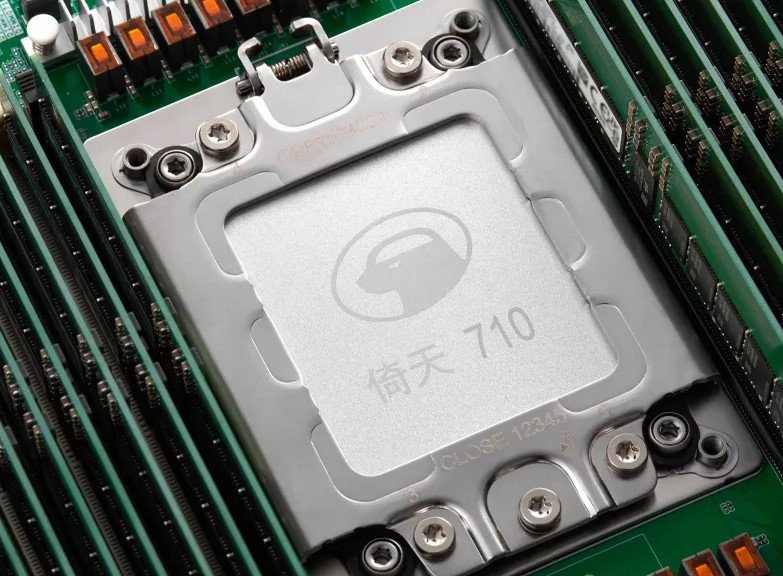
Alibaba has initiated structural preparations for an independent initial public offering for its semiconductor division, T-Head Semiconductor Co., Ltd. (Pingtouge). Designed to advance semiconductor self-sufficiency, T-Head produces the Yitian 710 ARM-based server processor, built on a 5-nanometer process with 60 billion transistors. Tracking the Alibaba T-Head chip spinoff date has become an important catalyst for institutional investors. A public offering would unlock sum-of-the-parts value while helping Alibaba substitute third-party computing hardware with proprietary silicon.
2. Powering Apple Intelligence in Mainland China
Regulatory rules from the Cyberspace Administration of China (CAC) require generative AI models deployed to domestic consumers to run on local servers and pass state reviews. To launch its AI features in China, reports indicate that consumer electronics maker Apple formed an Apple AI partnership Alibaba Cloud China. This enterprise agreement positions Alibaba to handle large-scale consumer inference across millions of iOS devices in mainland China.
3. Management’s 2.5 to 3-Year Breakeven Roadmap
On conference calls with institutional analysts, CEO Eddie Wu presented an operational model for Alibaba's AI investments. The company projects its intelligent computing infrastructure will reach an Alibaba cloud computing breakeven timeline within 2.5 to 3 years. The pathway relies on replacing merchant silicon with T-Head chips, which is expected to lower inference costs by 30% to 40% and support margin expansion.
6. Leadership Alignment: Executive Purchases and Institutional Sentiment
Large secondary placements can sometimes trigger governance concerns if investors worry about equity overhang. In this instance, Alibaba's top executives made personal market purchases to signal confidence in the company's valuation. Regulatory disclosures filed via HKEX Form 3A confirm the details of these Joe Tsai Eddie Wu insider purchases:
Joseph C. Tsai (Chairman)
- Volume: 720,000 Ordinary Shares
- Execution Price: HK$112.00 per share
- Capital Deployed: HK$80,640,000 (~US$10.30M)
Eddie Yongming Wu (CEO)
- Volume: 350,000 Ordinary Shares
- Execution Price: HK$111.60 per share
- Capital Deployed: HK$39,060,000 (~US$5.00M)
These insider purchases totaled HK$119.70 million (~US$15.3 million) in personal capital. Executed on the open market at the placement price, they helped reassure institutional allocators and establish a secondary support level for the equity.
7. Frequently Asked Questions (FAQ)
What were the exact terms of Alibaba's $10.2 billion share placement?
Alibaba issued 710,000,000 new ordinary shares at HK$112.70 each, raising HK$80.02 billion (~US$10.20 billion). The transaction was priced at an 8.37% discount to the previous close of HK$123.00, resulting in a 3.47% dilution of the company's enlarged share capital.
Why did Alibaba issue new shares with $46.5 billion in cash on hand?
Quarterly capital expenditures rose to 67.68 billion yuan against operating cash flow of ~25.68 billion yuan, creating an quarterly free cash flow deficit of ~42 billion yuan ($6.2 billion). Relying solely on onshore cash would have reduced operational reserves under its 380 billion yuan AI plan. The offshore placement secured long-term funding while preserving balance-sheet flexibility.
How does this placement affect U.S. ADR holders of BABA?
Because one BABA ADR equals eight Hong Kong ordinary shares, the 3.47% dilution applies equally across ADRs and HK ordinary shares. TTM normalized EPS declined by roughly 3.44%, while book value per share increased by 3.55% due to the cash influx.
Who participated in the institutional order book?
The placement saw total demand of $28 billion (oversubscribed by ~2.75x). More than 40% of the book was allocated to sovereign wealth and long-only funds, including Norway's Norges Bank, the Qatar Investment Authority, and Hillhouse Capital.
8. Investment Conclusion & Risk Disclosures
In answering whether is Alibaba stock a buy after placement, institutional investors weigh short-term dilution against long-term strategic positioning. The placement expanded cash reserves to $56.7 billion, and oversubscription from sovereign wealth funds indicates institutional support for Alibaba's cloud investments.
Over a multi-year horizon, Alibaba's performance will depend on operational execution: maintaining momentum in Cloud Intelligence revenue, commercializing open-weight Qwen models, and capitalizing on the planned spinoff of its T-Head chip business.
Regulatory and Financial Disclaimer: This equity analysis is published for institutional research and informational purposes by AurixFinance News and does not constitute financial, investment, or legal advice. Securities investments carry risks, including market volatility, foreign exchange risk, and potential loss of principal.
Authoritative Citations & Institutional Documentation: HKEXnews Regulatory Filings | U.S. Securities and Exchange Commission | Alibaba Group IR | IMF Global Markets | World Bank Data | OECD Economic Outlook | Bank for International Settlements | Federal Reserve | Gartner Research | IDC Worldwide Cloud Tracker | Stanford Institute for HAI | WIPO Patent Analytics | Statista Market Insights | Harvard Business Review | London Stock Exchange | Nikkei Asia | Caixin Global | Yahoo Finance.


